
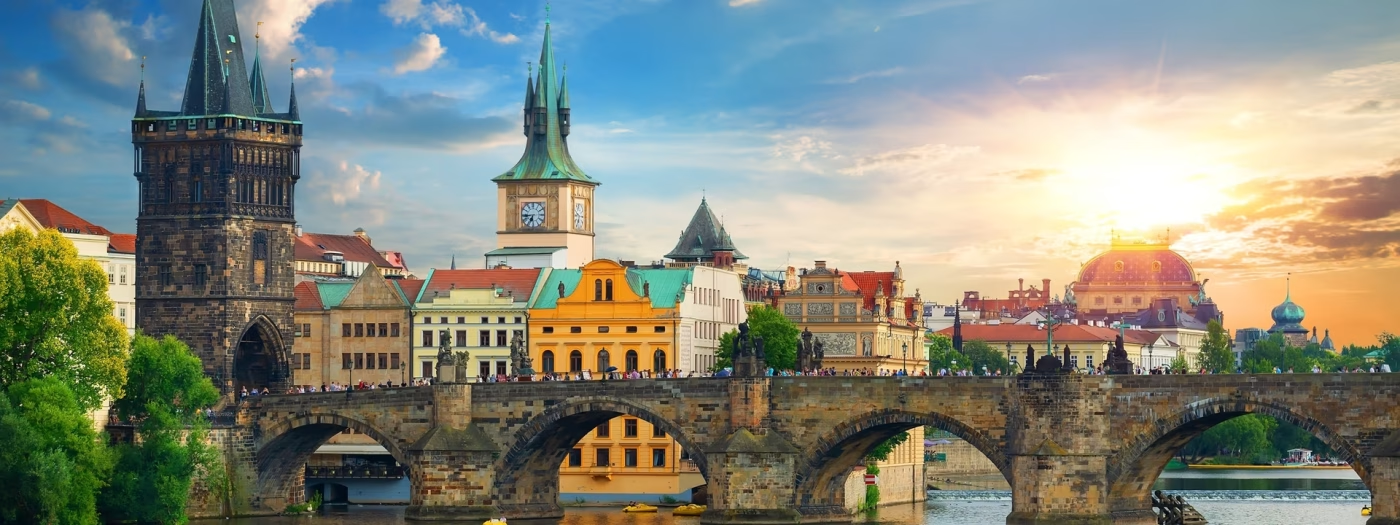
Planning your first trip to the Czech Republic in 2026? Whether you’re dreaming of Prague’s Old Town, castles and beer halls, or day trips to fairy‑tale towns like Český Krumlov, this Czech Republic travel guide 2026 gives you the foundations:
- Visa & Schengen basics
- Best seasons to visit (weather, crowds, prices)
- Overview of where to go (Prague + beyond)
- Safety, culture, etiquette
- Money, tipping & basic costs
Use this as your starting point before you plan detailed itineraries and “where to stay” guides for Prague and other cities.
1. Visas & Schengen Basics for the Czech Republic (2026)

The Czech Republic is part of the Schengen Area, which means the same visa rules and 90/180‑day stay limits apply as for many EU countries.
1.1 Who Needs a Schengen Visa for the Czech Republic?
In general:
- Citizens of EU/EEA/Swiss countries can enter and stay without a visa.
- Citizens of many countries (e.g. USA, UK, Canada, Australia, Japan, some Latin American countries) are visa‑exempt for short stays (usually up to 90 days in any 180 days).
- Many travelers from Asia, Africa and some other regions (for example Pakistan, India, Bangladesh, etc.) need a Schengen short‑stay visa (Type C) to visit the Czech Republic for tourism.
If you are from Pakistan or similar countries, you should assume you need a Schengen visa unless your passport is specifically listed as visa‑exempt.
Always confirm on:
- The Czech Embassy / Consulate website in your country
- The official Schengen visa information portal
1.2 Schengen Short-Stay Visa (Type C) – Basics
For a tourism trip (up to 90 days in any 180‑day period):
- Purpose: Tourism, visits, short business trips
- Validity: Usually allows travel within the entire Schengen Area, not only the Czech Republic
- Stay limit:
- Max 90 days total in the whole Schengen zone (not per country) in any rolling 180‑day window.
Where to apply:
- Normally at the Czech Embassy/Consulate or their outsourced visa center (e.g. VFS), if the Czech Republic is:
- Your main destination by number of nights, or
- The first point of entry if nights are equal in multiple Schengen countries.
Usual documents (summary, always check official list):
- Valid passport (+ copies)
- Completed application form
- Passport‑size photos
- Travel itinerary (flight bookings, hotel bookings, or invitation)
- Travel insurance (covering the Schengen area)
- Proof of funds (bank statements, sponsor letters)
- Employment or student documents (job letter, business proof, salary slips, or enrollment letter)
Apply well in advance (often 4–8 weeks before departure, more in busy periods or from countries with high demand).
1.3 Schengen Rules You Must Respect
- Don’t exceed 90 days in any 180‑day period in the whole Schengen area.
- Keep your entry/exit stamps and a simple log of your Schengen days if you visit multiple countries.
- Overstaying can cause fines, future visa refusals, and entry bans.
2. Best Time to Visit the Czech Republic
The Czech Republic has four distinct seasons, and your experience will change a lot depending on when you go.
2.1 Spring (March–May)

Pros:
- Warming temperatures, trees and parks turning green
- Fewer crowds than summer, especially in late March / April
- Good balance of weather and prices
Cons:
- March can still be chilly and gray
- Rain and unpredictable weather in early spring
Spring is great if you want:
- Prague + 1–2 day trips without peak season crowds
- More comfortable walking around narrow streets and hills
2.2 Summer (June–August)

Pros:
- Long daylight hours, warm to hot temperatures
- Lively atmosphere, outdoor cafes, beer gardens
- Many festivals and events
Cons:
- High season: more tourists, especially in Prague and Český Krumlov
- Accommodation prices higher
- Some days in July/August can be quite hot, and not all buildings have strong air conditioning.
Summer suits you if you:
- Don’t mind crowds
- Want outdoor life, late evenings out, and maybe combine with nearby countries (Germany, Austria, Poland, Slovakia).
2.3 Autumn (September–November)

Pros:
- September / early October: beautiful autumn colors, still mild weather
- Fewer tourists than summer after September
- Often good hotel rates compared to July–August
Cons:
- Late October–November can be gray and damp
- Days get shorter; some countryside attractions may have reduced hours
Autumn is ideal if:
- You want Prague + countryside (Bohemian Switzerland, South Bohemia) with fewer crowds
- You enjoy cafes, museums and walking in cooler weather.
2.4 Winter (December–February)
![17 Perfect Things to Do in Prague in Winter [2026] – Eternal Arrival](https://i0.wp.com/eternalarrival.com/wp-content/uploads/2018/11/prague-3010407_1280.jpg?w=1020&ssl=1)
Pros:
- Christmas markets (especially in December) in Prague and other towns
- Snowy, fairy‑tale feel possible in rural areas
- Fewer tourists in January–February; potential off‑season prices
Cons:
- Cold (often below 0°C), short daylight
- Some attractions and smaller tours closed or running with limited schedules
Great if you’re into:
- Winter city break with Christmas markets, hot mulled wine, cozy pubs
- Budget‑friendlier travel outside major holiday weeks.
3. Where to Go on Your First Trip: Prague & Beyond

On a first visit, most people focus on Prague, then add 1–3 day trips or extra stops.
3.1 Prague – The Main Base
Prague is the capital and your likely arrival city.
Key areas & highlights:
- Old Town (Staré Město): Old Town Square, Astronomical Clock, Charles Bridge access
- Lesser Town (Malá Strana): Cute cobbled streets under the castle hill
- Prague Castle area (Hradčany): The castle complex, cathedrals, viewpoints
- New Town (Nové Město): Wenceslas Square, shops, restaurants, nightlife
- Vinohrady / Letná / Holešovice: More local, trendy neighborhoods
You’ll need at least 3 full days to see:
- Old Town Square, Charles Bridge
- Prague Castle & St Vitus Cathedral
- Jewish Quarter (Josefov)
- Some local neighborhoods and parks.
3.2 Popular Day Trips from Prague
Good options for first-timers:
- Český Krumlov:
- Storybook town in South Bohemia, UNESCO‑listed
- Can be done in a long day trip or as an overnight
- Kutná Hora (Sedlec Ossuary):
- Bone church + historical town
- Easy day trip by train/bus
- Karlštejn Castle:
- Gothic castle near Prague
- Good for a half‑day or day trip
If you have 7–10 days, consider:
- 4–5 days in Prague
- 1–2 day trips
- 1–2 nights in another city or region (like Český Krumlov or Brno/Olomouc).
4. Safety & Basic Etiquette
4.1 Safety
Overall, the Czech Republic is considered safe for tourists, including solo travelers.
Common issues:
- Pickpocketing in crowded areas:
- Prague Old Town Square
- Charles Bridge
- Busy trams/metro in the city center
- Petty scams:
- Overpriced taxis if you don’t agree on the meter or use app
- Some exchange offices with bad rates (always check rate & commission first)
Basic tips:
- Keep valuables in a money belt or inside pocket, not in back pockets.
- Use reputable ATMs (inside banks) instead of random street ATMs.
- If you take a street taxi, ensure the meter is on or agree on a price before you start. Better: use local taxi apps.
4.2 Culture & Etiquette
- Czechs can seem reserved at first, but are friendly and helpful once you connect.
- A simple “Dobrý den” (good day) or “Děkuji” (thank you) is appreciated.
- In churches and religious sites, dress modestly (no need for extreme covering, just be respectful).
- In restaurants, waiters don’t rush; you usually ask for the bill when you’re ready (“Účet, prosím”).
5. Money, Currency & Basic Costs
5.1 Currency & Payments
- Currency: Czech koruna (CZK), not the Euro
- Many places in Prague center accept cards, but carry some cash for smaller shops and outside the main tourist zones.
- Use official ATMs (ideally at banks) and avoid “dynamic currency conversion” – always choose to pay/withdraw in CZK rather than your home currency.
5.2 Rough Cost Levels (2026, per person, per day)
These are rough, outside of very peak weekends or New Year.
- Budget: ~€40–60 / 1,000–1,500 CZK
- Hostel or simple guesthouse
- Cheap eats, supermarket lunches, public transport only
- Mid-range: ~€70–130 / 1,800–3,300 CZK
- 2–3★ hotel or nice apartment
- Restaurant lunches + dinners, a few beers or coffees, some attractions
- Higher budget: €150+ / 3,800+ CZK
- 4★–5★ hotels, frequent taxis, guided tours, wine bars, etc.
Prague is usually cheaper than Western capitals but more expensive than some Balkan destinations; touristy areas cost more than local neighborhoods.
6. Transport Basics: Getting Around the Czech Republic
6.1 Prague Public Transport
Prague has excellent public transport:
- Metro (subway) – fast and efficient for crossing the city
- Trams – scenic and useful in central neighborhoods
- Buses – fill in where metro/tram don’t go
Tickets:
- Time‑based (e.g. 30, 90 minutes, daily passes)
- You can buy at machines, some tram stops, apps or kiosks
- Validate when you first use them (stamp or electronic validation)
You can walk much of the historic center, but public transport saves time on hills and longer distances.
6.2 Intercity Trains & Buses
- Trains and buses connect Prague with:
- Other Czech cities (Brno, Olomouc, Plzeň, České Budějovice, etc.)
- Nearby countries (Germany, Austria, Slovakia, Poland)
Popular uses:
- Prague ↔ Český Krumlov (bus often faster/direct)
- Prague ↔ Vienna / Budapest / Berlin (train or bus options)
Book online or at stations; 2nd class is usually comfortable enough.
7. Practical Tips for First-Time Visitors
To wrap up this Czech Republic travel guide 2026, here are quick practical points:
- Plugs & Voltage:
- Plug types C/E most common (two round pins)
- Voltage 230 V / 50 Hz → bring a Type C/E/F adapter if needed.
- Language:
- Czech is the main language; English widely spoken in Prague tourist areas, less so in small towns.
- Learn a few basic words:
- Hello: Ahoj / Dobrý den
- Thank you: Děkuji
- Weather packing:
- Spring/autumn: layers and a light jacket
- Summer: light clothes + one warm layer for evenings
- Winter: real winter gear (coat, gloves, hat)
- Tipping:
- Rounding up the bill or 5–10% in restaurants is normal if service is good.
- In bars/cafes, small rounding is appreciated but not strictly required.
- Water:
- Tap water is generally safe to drink; ask locally if unsure.
- Tourist taxes:
- Some accommodation may add a small local tourist tax per night; usually minimal.